Technology
The perfect sound is in the details
The Four Dimensions of Technology
Acoustic Design doesn't want to simply "just" develop and manufacture top-quality speakers. For us, you—our customer and music lover—are the focus. We want to stir emotions in you when you listen to your favorite songs. Or even when you hear a piece of music for the first time.
To achieve this, we combine our four “D’s” of design across four dimensions. This requires expertise and experience from a wide variety of specialized fields. And this expertise needs a technically advanced environment in which to flourish. Learn more on the “Acoustic Design” page.
On this page, you'll find all the ingredients you need to put our four D's into practice.
The Chassis
Our "
" Point Sound Sources
The first and most important of the four design dimensions is “Acoustic Design.” At the heart of this are our point sound sources, which we implement in various ways depending on the product line.
In our Art series, we use a coaxial driver with a beryllium tweeter and a magnesium midrange or low-midrange driver.
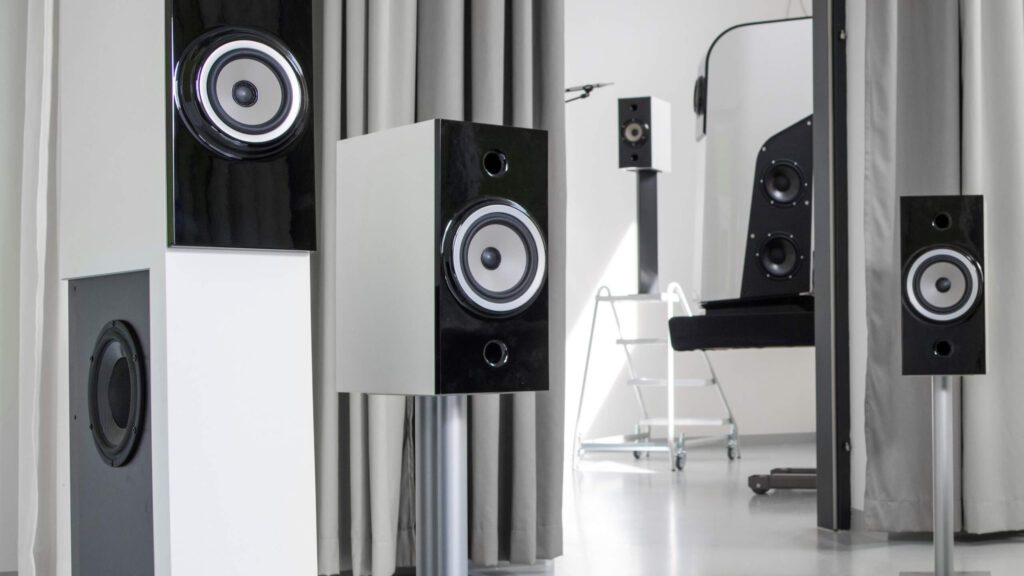
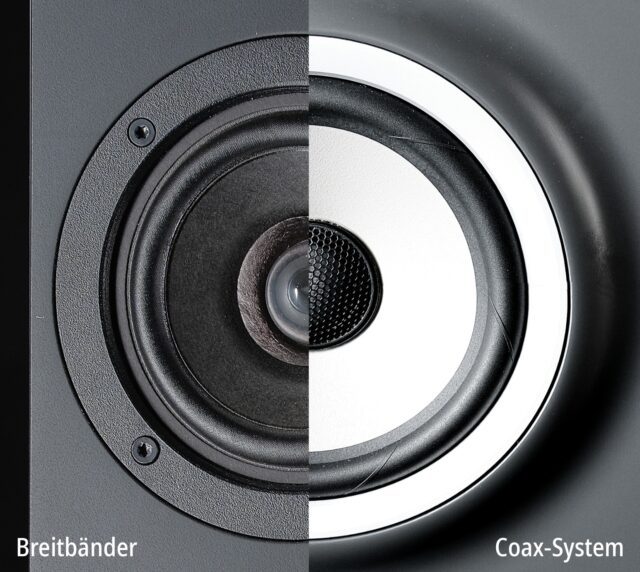
The Comp series features 3- and 4-inch wideband systems that, thanks to their design, function as a single sound source.
Very close to the point source
In a coaxial driver, the tweeter is positioned at the acoustic center of the midrange or low-midrange driver. In a full-range driver, there is only a single sound source to begin with.
This design enables perfectly symmetrical sound dispersion in all directions and brings us very close to the ideal of a point source, with simultaneous sound emission from the tweeter and the midrange or low-midrange driver.
The result is a soundstage with extremely precise spatial imaging and outstanding depth. The localization of individual instruments is exceptional, and we create a soundscape that offers you an unparalleled musical experience.
Simultaneous Sound Emission from the Midrange and Tweeter
In our quest for near-perfect sound, we place great importance on simultaneous sound radiation. This means that the sound produced by the tweeter and the midrange or low-midrange driver travels the same distance to the listeners.
Technically, this is referred to as a constant group delay from the tweeter and midrange driver or low-midrange driver. We achieve this nearly perfectly with our coaxial driver. Thanks to this simultaneous sound radiation, you’ll experience not only the arrangement of the instruments in the room but also the acoustic conditions of the recording studio in a more realistic way.
Beryllium Tweeter
Beryllium combines high rigidity with low weight, superior sound velocity, and excellent natural damping. These properties make it the ideal material for precise, fast tweeters. The result is an exceptionally clear, clean sound that reveals even the finest details and previously hidden nuances of a recording.
Magnesium midrange or low-midrange driver
Magnesium combines low weight with high rigidity and good internal damping. This enables smooth, piston-like diaphragm movement, reduces partial vibrations, and improves the chassis’s damping characteristics. The result is clearer, lower-distortion midrange reproduction for even better sound quality.
Wide Ribbons Made from Natural Materials
The components: paper cone with bamboo fiber, aluminum phase plug, bottom-mounted voice coil.
The die-cast aluminum basket ensures stable, resonance-free conditions.
And in the Comp.8 full-range driver, the paper diaphragm is complemented by the fabric surround, the ultra-thin tweeter cone, and the active phase plug. All of these components enable seamless sound reproduction from 150 Hz to 21 kHz.
Our Low-Frequency Drivers
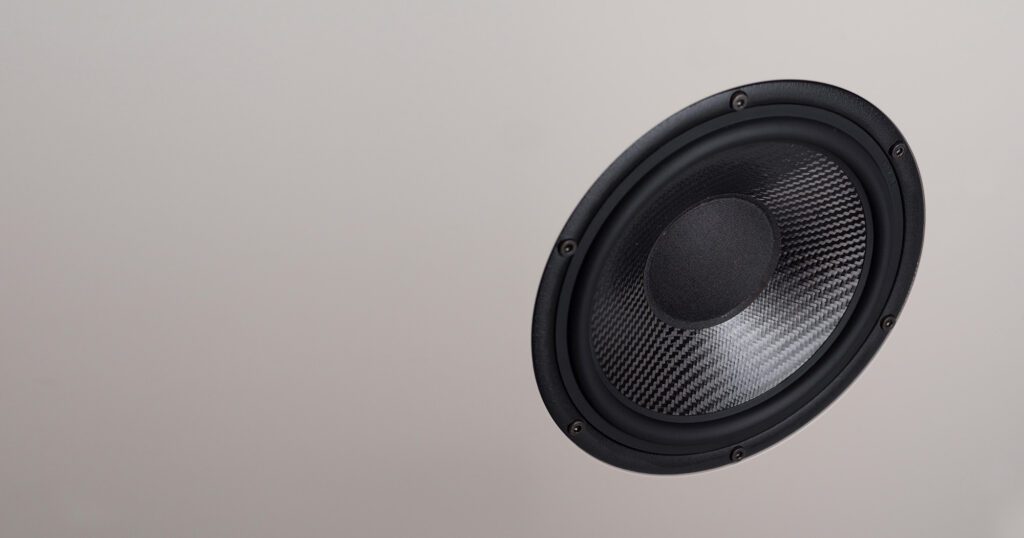
Our Art One.2 features a handcrafted woofer with a carbon cone.
Carbon is an extremely lightweight and extremely rigid material—the ideal material for a woofer driver.
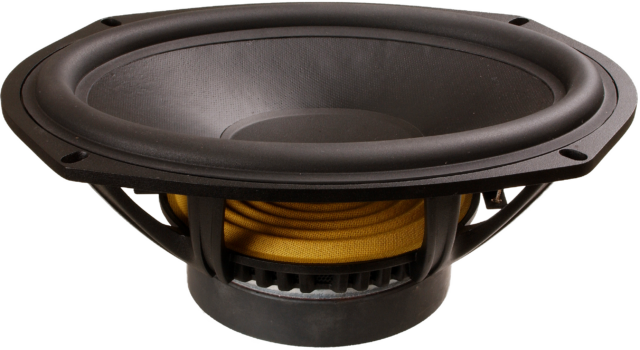
In the Comp.3 and Comp.5, we use a driver with an oval 6×9″ basket.
This is the only way to achieve the narrow front and sleek appearance with the curved side panels.
The Enclosures
"Form follows function"
, and "function follows form"
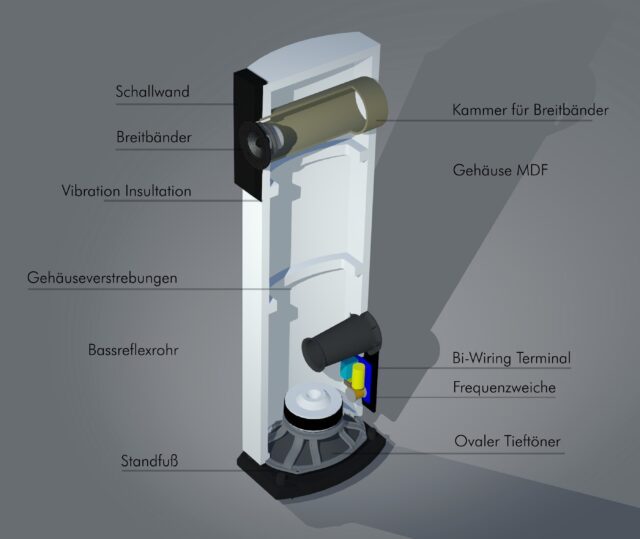
The design of our enclosures combines Acoustic Design’s “Visual D” with all the requirements for optimized sound reproduction—our acoustic “D.” The curved enclosure shapes of the Comps, resonance-optimized materials (steel ball mats), and bracing provide the perfect foundation for our high-end drivers.
Interferometric
Method
As early as 1987—at that time still by “Audiodata Elektroakustik GmbH”—the advantages of a loudspeaker enclosure whose internal chambers were lined with mats filled with steel balls were investigated as part of a thesis at the Fraunhofer Institute. Using a laser-controlled interferometric method, the resonance advantage over a conventional speaker enclosure was measured.
These mats consist of small chambers filled with tiny steel balls. Microscopic movements of the balls within the chambers optimize the resonance of the speaker enclosures. This method virtually completely absorbs the unwanted resonance of the enclosure. The result is a uniquely clear, precise sound image in which only the speaker drivers are audible.
Since that study, all of our speaker enclosures have been lined on the inside with steel ball mats backed with felt.


Finite Element Method
In 1996, as part of another thesis project—at that time still conducted by “Audiodata Elektroakustik GmbH”—the finite element method was used in the development of the timeless classic “Elance.”
A crucial step in optimizing speaker enclosures.
As part of a project with the crane manufacturer Palfinger, we analyzed the Art Two housing using the finite element method in 2018—already in Salzburg at that time.
The goal of this project was to determine which forces act on the chassis mounting in the enclosure and on all enclosure components as a result of the deflection of the chassis diaphragm. This made it possible to identify corresponding enclosure deformations and weak points and subsequently reduce or eliminate them.
The Electronics
Active and Stream Models
The third “Design-D” of our four dimensions: The electronics and software for our active and Stream Wireless models were also developed entirely “in-house” at Acoustic Design.
This is the only way we can ensure that the electronics are perfectly tuned to the speakers' characteristics and maintain full flexibility.
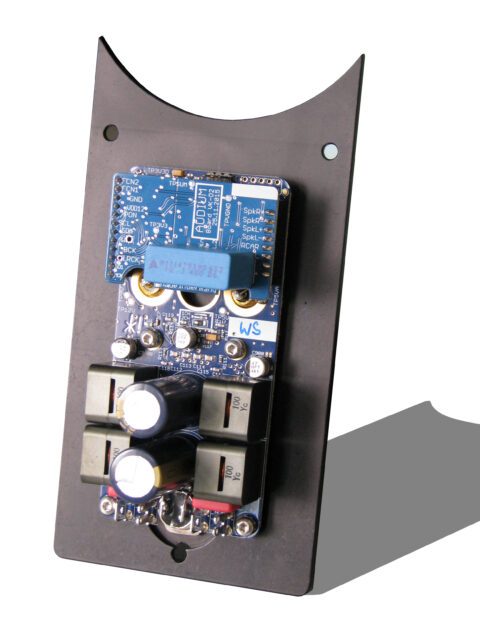
What they all have in common is the motherboard with a DSP, microprocessor, and 2-channel Class-D digital power amplifier. The crossover and all settings for room correction and EQ are handled digitally without unnecessary DA conversion.
The active models are equipped with a daughterboard featuring an AD converter, while the Stream Wireless models come with a stack of boards: a Wi-Fi receiver (AirPlay, UPnP, streaming services, and Bluetooth), an SRC board with a sample rate converter and SPDIF digital inputs and outputs, and a wireless board for the digital transmission of audio data to the second speaker.
TheConductor App
Your ADs are the orchestra,
and you are the conductor
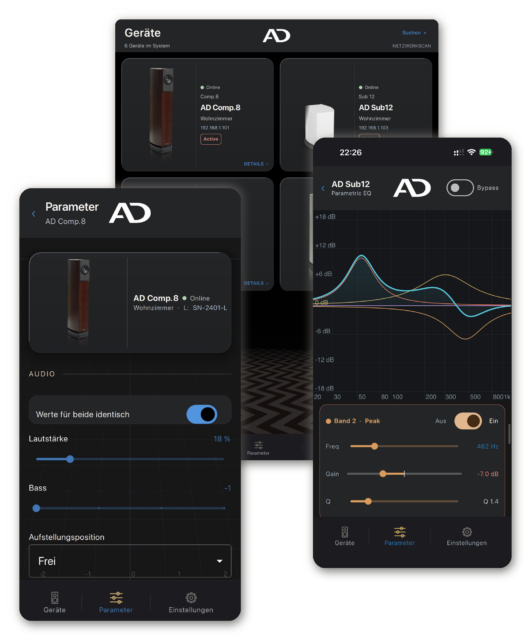
Our Active and Stream Wireless models can be easily set up using the “AD Dirigent App.”
All speaker parameters—such as position, bass, and room characteristics—can be conveniently configured.
We are constantly working on further developments to increasingly address the “fourth D of design”: room acoustics.
To ensure that every user can stick with their preferred platform, the app is available for iOS, Android, Windows, macOS, and Linux.